

Alibaba is shipping the Qwen4 architecture before it ships a Qwen4 model.
The Hugging Face page for Qwen3.8-Flash-Next is still a countdown, not a model card. The label is deliberate: “A Preview of the Qwen4 Architecture.” TechNode, citing Chinese reporting, says the open-weight checkpoint and an FP8 variant are due at 23:00 Beijing time on 26 August 2026. That is 20:30 IST. This is not a finished flagship. It is an early look, shipped so runtimes and quantizers can prepare before the full family lands.
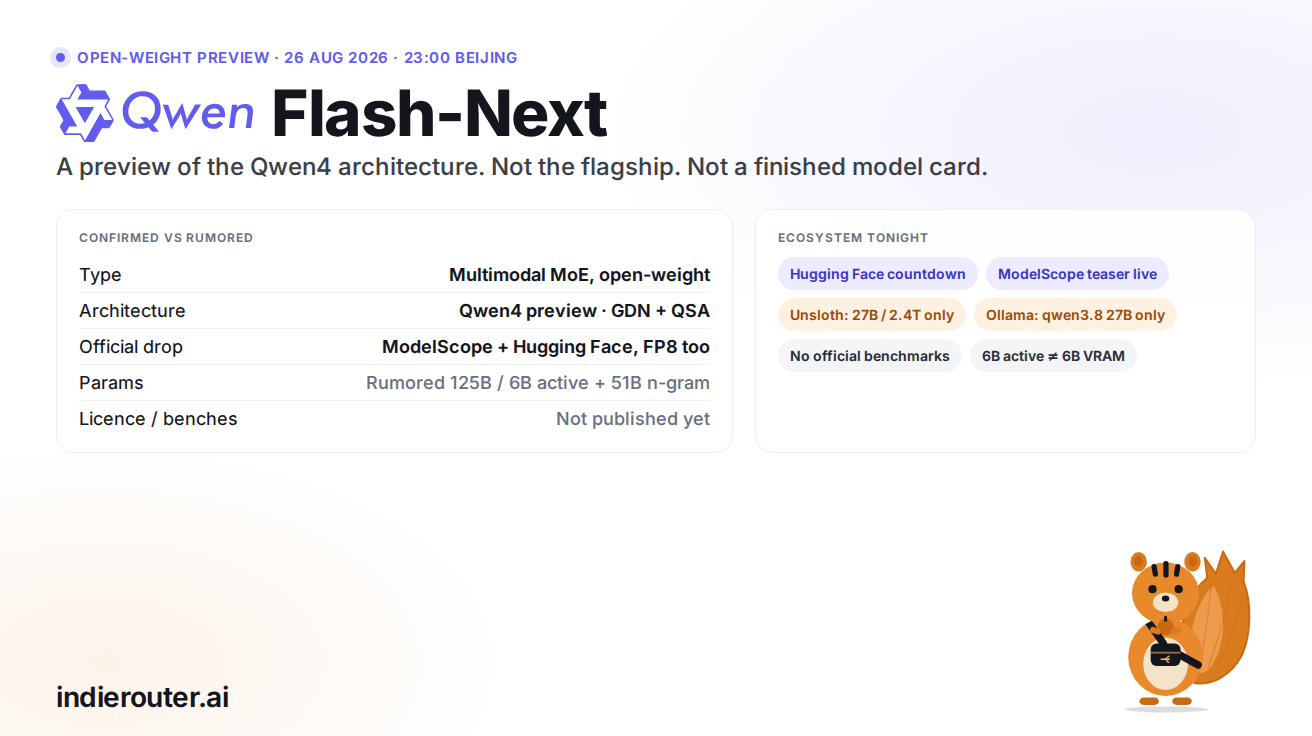
For Indian teams the useful question is not “is this Qwen4?” It is what is actually confirmed, what is still rumor, and whether Unsloth, Ollama, or Hugging Face have anything you can run tonight.
What is confirmed
The live teasers and Qwen’s own framing agree on a short list.
| Claim | Status |
|---|---|
| Open-weight multimodal MoE | Confirmed in the teaser |
| Built on the next-generation Qwen4 architecture | Confirmed. This is not Qwen4 itself |
| GDN hybrid layers + Qwen Sparse Attention (QSA) | Confirmed in Qwen’s statement |
| Drop window | 26 August 2026, 23:00 Beijing / ModelScope + Hugging Face |
| FP8 variant with the main checkpoint | Reported by TechNode from official Chinese coverage |
| Parameter count, licence, context, benchmarks, API price | Not published |
Alibaba’s stated reason is the interesting part. The architectural changes should be in the community’s hands before the family arrives, so that kernels, quants, and apps are ready when the real thing ships. Qwen3-Next played the same role in late 2025 for Gated DeltaNet. The documentation and the production family came later.
What leaked, then vanished
A ModelScope page briefly carried more numbers, then was edited down. Multiple independent captures agree on the same three bullets, so treat them as prematurely published official copy, not as a settled card.
| Captured figure | How to read it |
|---|---|
| ~125B main parameters | Rumor with high confidence. Not on the live card |
| ~6B active per token | Same. About 4.8% of the main model fires per token |
| Extra ~51B n-gram embeddings | Lookup table, not ordinary weights. Some posts round the whole thing to ~176B |
| ~1/9 the training cost of Qwen3.7-Plus | Marketing claim. No benchmark table backs it |
| Stronger on coding and “cowork” | Agentic, multi-step work is the pitch. Still no scores |
Community posts have also rounded this to “120B-A6B.” Close enough as a nickname, not a spec. Until the config.json lands, do not buy hardware on either number.
The n-gram table is the part that actually changes the local-AI math. If it has to sit in fast memory, this is a 128 GB class model. If it can stream from SSD, the buyer set gets much wider. Nobody has that answer yet.
What Unsloth, Ollama, and Hugging Face have today
This is the gap most recaps skip.
Hugging Face. Qwen/Qwen3.8-Flash-Next is an upcoming-release page. As of this writing it still shows a countdown and a planned artifact, not weights. Over 2,000 people are waiting on notify.
Unsloth. Their live Qwen3.8 guide covers Qwen3.8-27B and Qwen3.8-2.4T-A95B. The 27B 4-bit path runs on 16-19 GB. The 2.4T flagship shrinks from 4.9 TB BF16 to a 397 GB Dynamic 1-bit GGUF. Their catalog and docs do not yet list Flash-Next. That is expected: there is nothing to quantize until the checkpoint exists. Unsloth usually aims for day-zero support on Qwen drops, but QSA and a new n-gram block are genuinely new architecture. llama.cpp support for novel attention has historically taken days, not hours.
Ollama. The official qwen3.8 library tag is the 27B vision model, about 18 GB, 256K context. There is no Flash-Next tag. Do not type ollama run qwen3.8 tonight and expect the Qwen4 preview.
| Source | What you can get today | Flash-Next |
|---|---|---|
Hugging Face Qwen/Qwen3.8-Flash-Next | Countdown page | Weights not live |
| Unsloth docs / GGUFs | 27B + 2.4T-A95B | Not listed |
Ollama qwen3.8 | 27B vision, ~18 GB | No tag |
| ModelScope | Official teaser + promised FP8 | Same 23:00 Beijing window |
Why 6B active is not a 6B GPU bill
Sparse MoE lowers compute per token. It does not shrink storage. The full expert pool still has to live in some mix of VRAM, RAM, and disk. That is the same lesson as Qwen3-Next (80B total / 3B active) and Qwen3.8-Max (2.4T / ~95B active). Flash-Next, if the leak holds, sits between them: more capacity than the dense 27B, far cheaper to run per token than the flagship.
The 27B remains the model you can actually build on today. It is dense, Apache 2.0, vision-capable, and Unsloth already ships Dynamic v3 GGUFs and NVFP4 for it. Flash-Next is the architecture canary sitting next to that.
Licence is the other unknown
Qwen3.8 already split the word “open.” The 27B is unmodified Apache 2.0. The 2.4T flagship shipped under a custom qwen3.8-max licence with a revenue-share tier. Flash-Next has no published terms. Assuming Apache 2.0 because earlier Qwen drops were permissive is how teams create legal work for themselves later. Wait for the card.
What Indian teams should do tonight
- Watch the ModelScope and Hugging Face repos at 20:30 IST. Confirm parameter count, licence, and whether an FP8 shard actually appears.
- Do not rebuild production on day-zero kernels. Route a copy of a real workload at it once a runtime exists, and keep the 27B as the fallback.
- Do not buy a 128 GB box on the 6B-active headline. Wait for a real quant table from Unsloth or llama.cpp.
- For DPDP, an open-weight multimodal MoE you can host in India is the interesting shape. The compliance story only starts after the licence is readable and the prompts stay on Indian GPUs.
How this fits IndieRouter
IndieRouter serves open-weight models from Indian GPUs, OpenAI-compatible, billed in INR with GST, with prompts that never leave the country. Qwen3.8-27B is already on the roadmap. Flash-Next is not live and is not on the board yet. When a Qwen4-based checkpoint ships with a licence we can serve, it lands the same way everything else does: on Indian GPUs, with no prompt retention, and no data leaving India.