

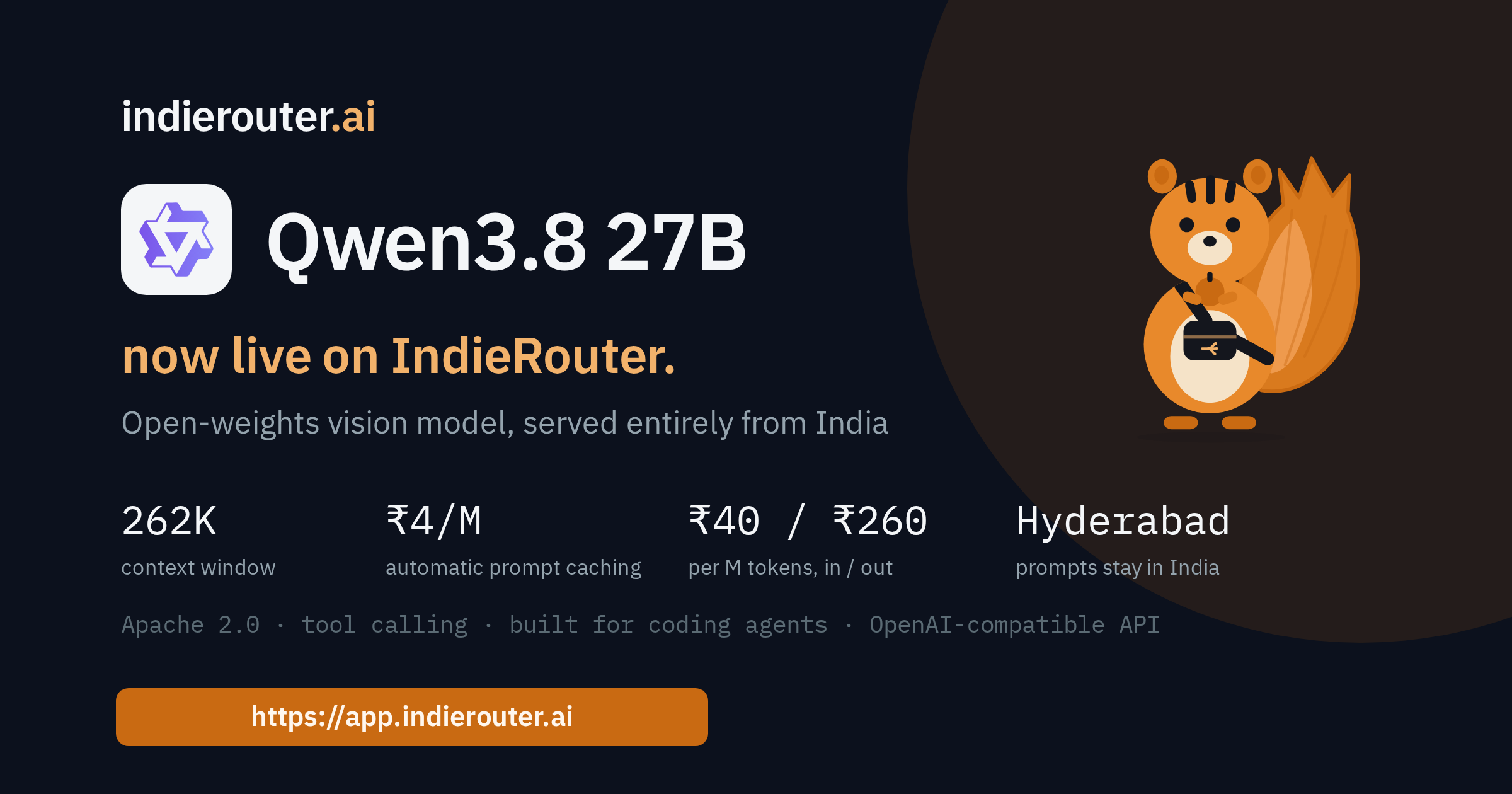
Qwen3.8 27B is live on IndieRouter today, at model: "qwen3.8-27b". It is our second chat model and our first vision-capable one: 262K context, images in, priced to run all day. It runs on our own GPUs in India, so the same sovereignty guarantee that applies to everything else on the platform applies here: prompts never leave India, and nothing you send is retained for training.
DeepSeek V4 Flash remains our flagship for the hardest reasoning work. Qwen3.8 27B is the fast, affordable tier next to it: the model you reach for when you want an agent to iterate quickly, read a screenshot, or chew through a long document without the flagship’s price tag.
What it is
Qwen3.8 27B is a 27-billion-parameter vision-language model with a hybrid-attention architecture and a 262,144-token context window. It accepts images as input alongside text. The license is Apache 2.0, and we serve the RadixArk NVFP4 quantization, with the model card linked from the catalog like every model we host.
It is a particularly good fit for coding agents: the 262K context holds a real repository slice plus a long tool-call transcript, tool calling is strong (we run the qwen3_coder parser), and the model’s reasoning is separated into the reasoning field of the response, so your application gets clean final answers with the thinking available when you want it.
How we serve it
We run this model on GPUs we own, not rented capacity, and the serving stack is engineered for it specifically: speculative decoding (DFlash 2) plus a hierarchical KV cache, tuned for the workloads a 262K-context model actually attracts. Long system prompts, repository-sized context, and multi-turn agent transcripts are the design target, not an afterthought.
The practical result is a fast, responsive endpoint that stays that way as your prompts grow: cached prefixes skip recomputation entirely, and speculative decoding does its best work on exactly the kind of structured, predictable text that coding and agent workloads produce.
Pricing
Flat 24/7 rates, billed in rupees, ex-GST:
| Rate | INR per million tokens | USD equivalent (approx) |
|---|---|---|
| Input | ₹40 | $0.42 |
| Cached input | ₹4 | $0.042 |
| Output | ₹200 | $2.09 |
The USD column is at the current feed rate, for comparison only; you are billed in INR. On OpenRouter, output pricing for this model currently sits between $3.00 and $3.40 per million across listed providers (checked 2026-08-23), so the ₹200 output rate undercuts every one of them.
Updated 2026-08-23: output cut from ₹260 to ₹200 per million. Input and cached input are unchanged.
Prompt caching is automatic. There is no code change and no cache-control header to set: repeated prefixes (system prompts, few-shot examples, long documents queried repeatedly) hit the cache and bill at ₹4 per million instead of ₹40. Cache hits are reported per request in usage.prompt_tokens_details.cached_tokens, so you can see exactly what you saved.
Where it sits next to DeepSeek V4 Flash
An honest guide to picking between the two:
- DeepSeek V4 Flash (₹30/M input, ₹95/M output) stays the flagship: deepest reasoning, cheapest output. Use it for hard analysis and generation-heavy work.
- Qwen3.8 27B is the affordable everyday tier and the only one that can see. Use it for agent loops, tool-heavy workflows, anything with images, and interactive products where responsiveness matters.
Both share the same 262K context window, the same API surface, and the same India-based hardware.
Try it in two minutes
The API is OpenAI-compatible: point your existing SDK at our base URL and change the model id.
curl https://api.indierouter.ai/v1/chat/completions \
  -H "Authorization: Bearer $INDIEROUTER_API_KEY" \
  -H "Content-Type: application/json" \
  -d '{
    "model": "qwen3.8-27b",
    "messages": [{"role": "user", "content": "Summarize DPDP data-localization requirements in three bullets."}]
  }'
from openai import OpenAI
client = OpenAI(
base_url="https://api.indierouter.ai/v1",
api_key="YOUR_INDIEROUTER_API_KEY",
)
response = client.chat.completions.create(
model="qwen3.8-27b",
messages=[{"role": "user", "content": "What changed in this diff?"}],
)
print(response.choices[0].message.content)
print(response.usage.prompt_tokens_details.cached_tokens)Vision works through the standard OpenAI image-content format: send an image URL or base64 part in the message content and ask questions about it.
Sovereign by architecture, as always
Qwen3.8 27B runs on GPUs we own, in a data center in India, in the in-hyderabad-1 region. Your prompts and images are processed in India and never leave it, and we retain nothing for training, zero. For teams with DPDP obligations, or customers who ask “where does the data actually go”, the answer is the same one we give for every model we serve: it stays here. That is a property of where the compute lives, not a line in a data processing agreement.
Get started
Sign up at app.indierouter.ai, create an API key, and qwen3.8-27b is available immediately on prepaid credits with a GST invoice on every charge. Full rates and plans are on the pricing page, and the model card is linked from the catalog.
Building a product on top of inference, or reselling to your own customers? Ask us about the partner program at enterprise@indierouter.ai.