

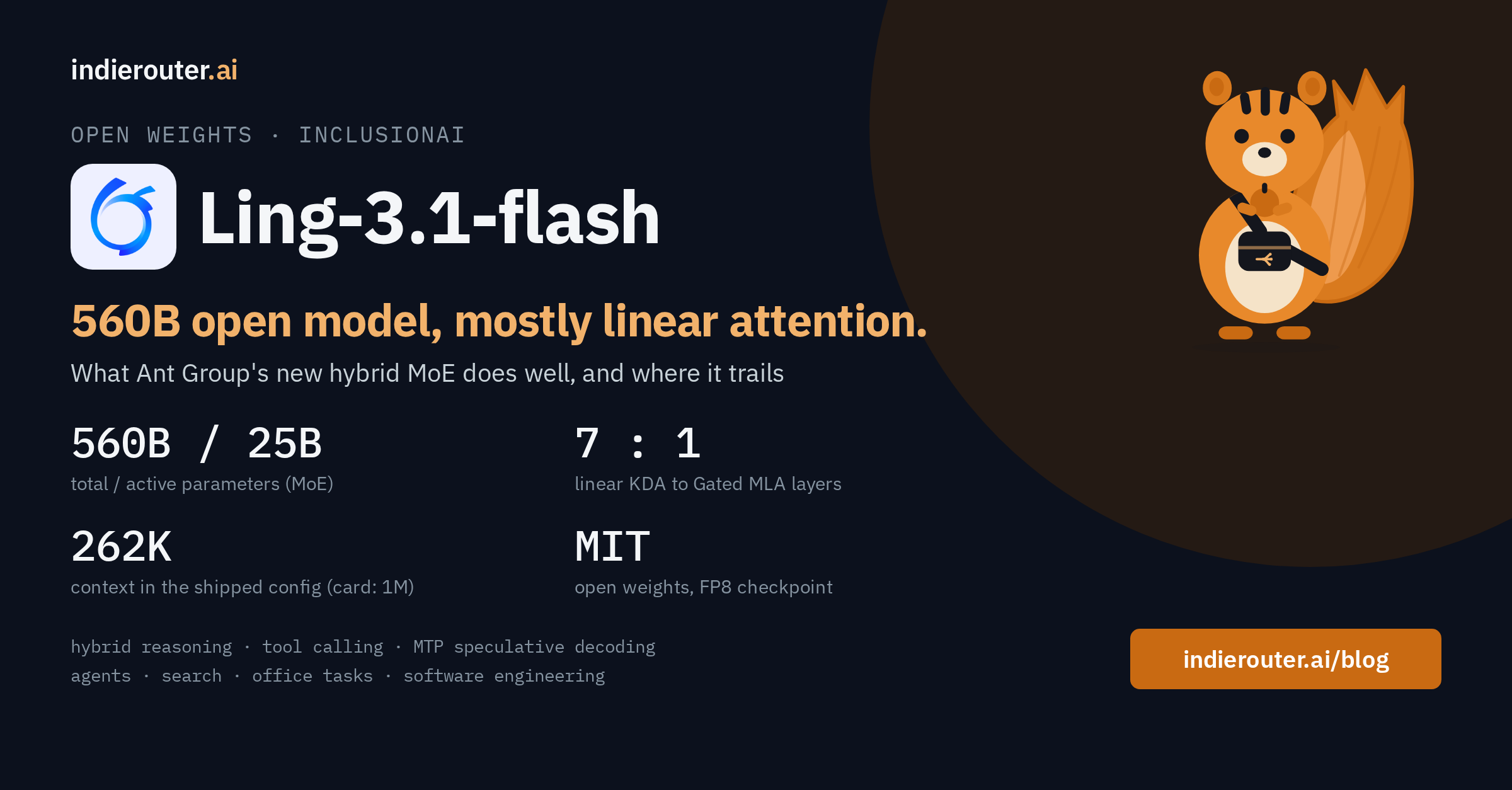
On 13 October 2026 inclusionAI, the AI research group behind Ant Group’s Ling, Ring and Ming model families, published the weights of Ling-3.1-flash on Hugging Face. It had been available through OpenRouter since 2 October; the open checkpoint is the news. It is a 560 billion parameter mixture-of-experts model with 25 billion parameters active per token, released under the MIT licence.
The parameter count is not the interesting part. Plenty of open models sit in the 500B class now. What sets Ling-3.1-flash apart is that seven out of every eight of its layers do not use conventional attention at all.
A model that is mostly linear attention
Ling-3.1-flash has 72 transformer layers arranged in nine groups of eight. In each group, seven layers use Kimi Delta Attention (KDA), the linear-attention design Moonshot introduced with Kimi Linear, and one layer uses Gated Multi-head Latent Attention (MLA), the compressed attention DeepSeek popularised. That is 63 KDA layers and 9 MLA layers.
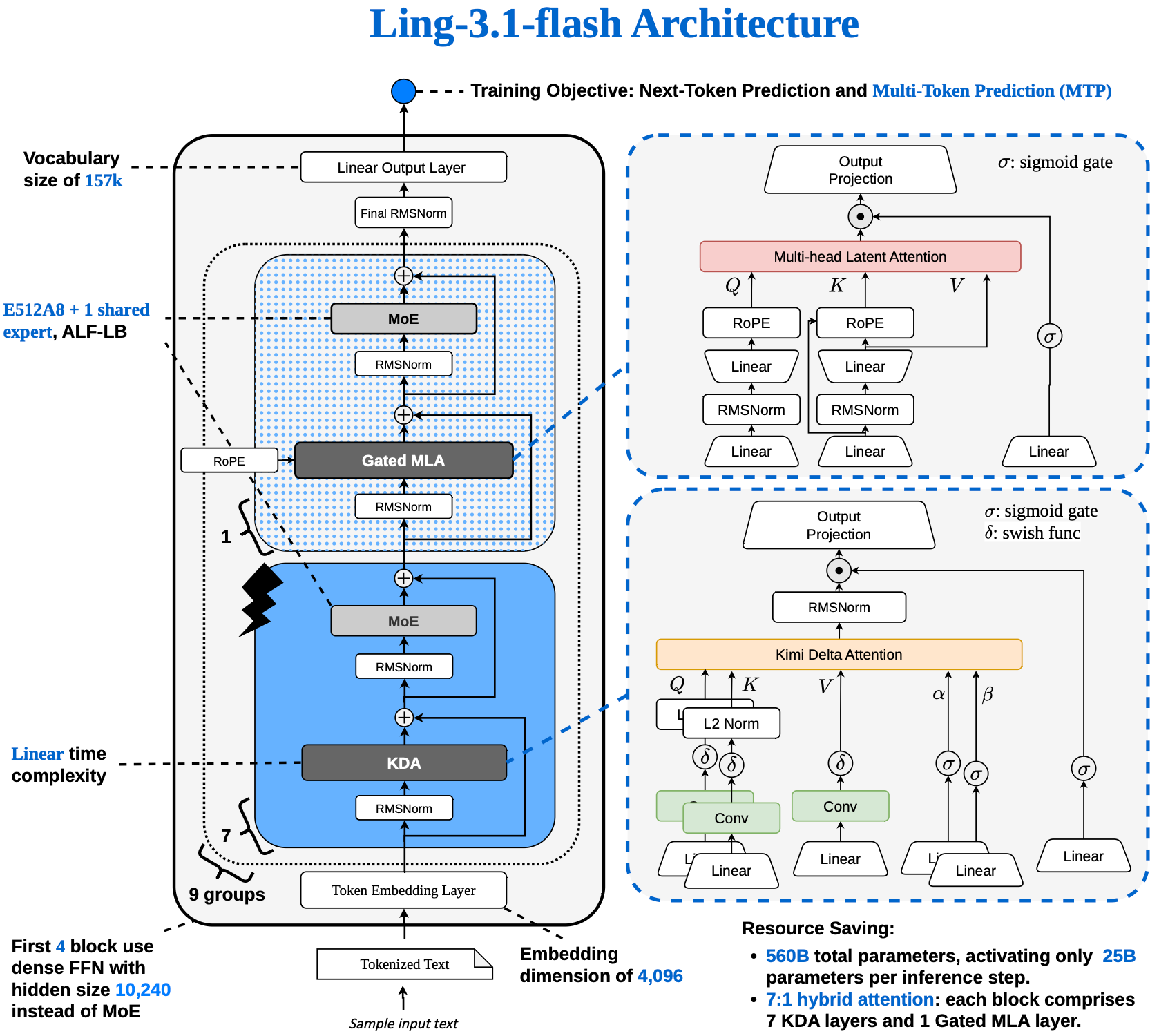
The difference matters for anyone serving the model. A conventional attention layer keeps a key-value cache that grows with every token in the conversation. A KDA layer keeps a fixed-size recurrent state instead, so its memory cost does not grow with context length. With only one layer in eight holding a growing cache, and that cache already compressed by MLA, long conversations are far cheaper to hold in GPU memory than on a full-attention model of the same size. Long-running agents, which re-read the same growing transcript on every turn, are exactly the workload that benefits.
The rest of the design is a familiar large MoE:
| Spec | Ling-3.1-flash |
|---|---|
| Developer | inclusionAI (Ant Group) |
| Architecture | Hybrid-linear MoE |
| Total parameters | 560 billion |
| Active parameters | 25 billion per token |
| Layers | 63 KDA + 9 Gated MLA (7:1), first 4 with dense FFN |
| Experts | 512 routed, 8 active, plus 1 shared |
| Hidden size | 4,096 |
| Vocabulary | 157,184 tokens |
| Context window | 262,144 tokens in the shipped config (model card says 1M) |
| Weights | FP8 (E4M3, 128x128 blocks) |
| Extras | Multi-token prediction head for speculative decoding |
| Licence | MIT |
One number needs a footnote. The model card describes a 1M-token context window, but the config.json in the same repository sets max_position_embeddings to 262,144 with no RoPE scaling, and both SGLang’s deployment cookbook and OpenRouter list 262,144 tokens. Plan around 262K until inclusionAI publishes a configuration that says otherwise. Similarly, the SGLang cookbook puts active parameters at about 17B, against the card’s 25B; the gap is most likely whether embeddings and attention are counted, and it does not change the serving picture much.
What the benchmarks say
inclusionAI compared Ling-3.1-flash against GPT-5.6 Sol, Claude Opus 5, Kimi K3, GLM 5.3, GLM 5.3 Flash and DeepSeek-V4.1-Flash across twelve benchmarks. Ling-3.1-flash is the blue bar in each panel.
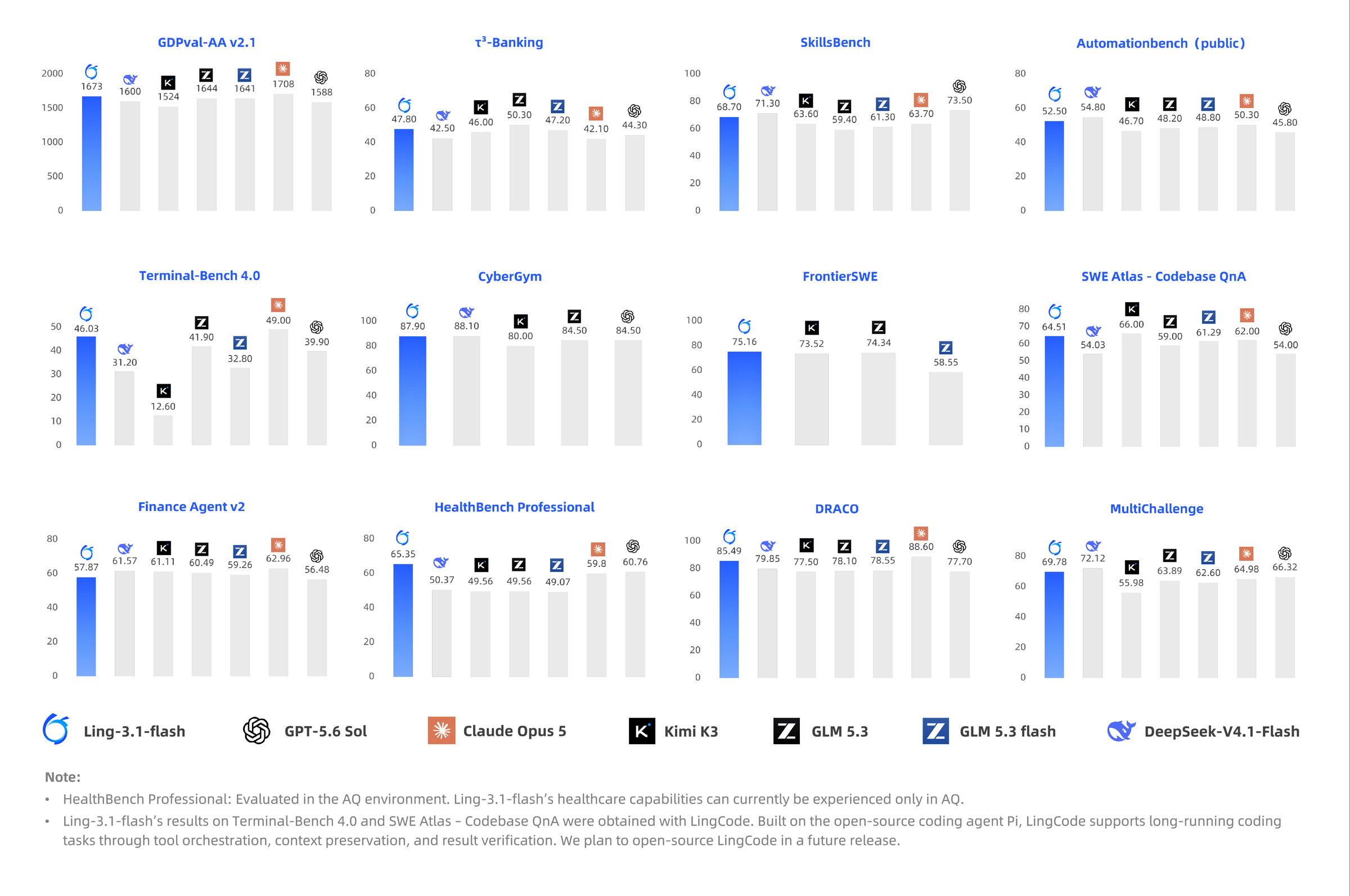
Read across the panels and a clear pattern shows. Ling-3.1-flash finishes first on two benchmarks, second on eight, and lower on the remaining two:
- First: HealthBench Professional (65.35, against 60.76 for GPT-5.6 Sol) and FrontierSWE (75.16, against 74.34 for GLM 5.3; only four models were reported there).
- Second: GDPval-AA v2.1 (1673, behind Claude Opus 5 at 1708), Terminal-Bench 4.0 (46.03, behind Claude Opus 5 at 49.00), τ³-Banking, Automationbench, CyberGym, SWE Atlas Codebase QnA, DRACO and MultiChallenge.
- Lower: third on SkillsBench (68.70, GPT-5.6 Sol leads at 73.50) and sixth of seven on Finance Agent v2 (57.87, Claude Opus 5 leads at 62.96).
For a model with 25B active parameters, consistently landing just behind the closed frontier on agentic and office-work tasks is a strong result. The closest like-for-like comparison is DeepSeek-V4.1-Flash, another open-weight MoE in the same weight class. On inclusionAI’s chart, Ling-3.1-flash leads it on GDPval, τ³-Banking, Terminal-Bench, SWE Atlas, HealthBench and DRACO, and trails on SkillsBench, Automationbench, Finance Agent and MultiChallenge, with CyberGym a near tie.
Three caveats belong next to those numbers:
- These are the vendor’s own results. Independent evaluations have not landed yet.
- The Terminal-Bench 4.0 and SWE Atlas scores were produced with LingCode, inclusionAI’s own coding harness built on the open-source agent Pi, which is not yet released. Other models were not necessarily run in the same harness, so those two panels compare model plus harness, not model alone.
- HealthBench Professional was evaluated in the AQ environment, Ant Group’s health app, where the model’s healthcare capabilities can currently be experienced. Expect a different number through a plain API.
Serving it
Day-zero support exists in both major open inference engines. SGLang ships a dedicated image, lmsysorg/sglang:dev-ling-3.1-flash, with the ling3 reasoning and tool-call parsers and multi-token prediction speculative decoding; its cookbook reports a measured acceptance length of 2.13 tokens on real text. vLLM support currently lives on a branch, launched with --reasoning-parser ling3, --tool-call-parser ling3 and --mamba-cache-mode align. The reference recipe fits on a single multi-GPU server at FP8.
That last vLLM flag points at the one operational wrinkle. Because KDA layers carry recurrent state rather than a plain key-value cache, prefix caching has to snapshot that state at block boundaries, and both engines need hybrid-specific cache settings to get it right. We have run hybrid linear-attention models in production before, and the lesson carries over: verify that a repeated long prompt actually reports cached tokens, and that the answers are still correct after the cache has been evicted and refilled, before trusting either the speed or the bill.
The recommended sampling settings are temperature 1.0, top_p 0.95 and top_k 20, with thinking switched on through chat_template_kwargs: {"enable_thinking": true}.
The licence is the easy part
Unlike the custom licences on several recent frontier-class open models, Ling-3.1-flash ships under plain MIT. You can self-host it, fine-tune it and build commercial products on it without a revenue threshold or a usage policy to negotiate. inclusionAI has also published a training-content summary for the model, a disclosure that most labs still do not provide.
For an Indian team, that combination is the useful part: a capable agentic model whose weights you can hold, under terms a lawyer can read in five minutes. Where you run it is then a question of GPUs and jurisdiction, not permission.
Ling-3.1-flash and IndieRouter
Ling-3.1-flash is not in the IndieRouter catalogue today. Every model we add has to pass the same gates on our own GPUs in India before it takes traffic, including long-context recall, cached-prefix correctness and strict tool calling, and a new hybrid architecture gets that treatment before it gets a price.
If you want Ling-3.1-flash served from India with rupee billing and GST invoices, tell us. Demand is how we decide what to bring up next. In the meantime, our current models are available through the same OpenAI-compatible API.